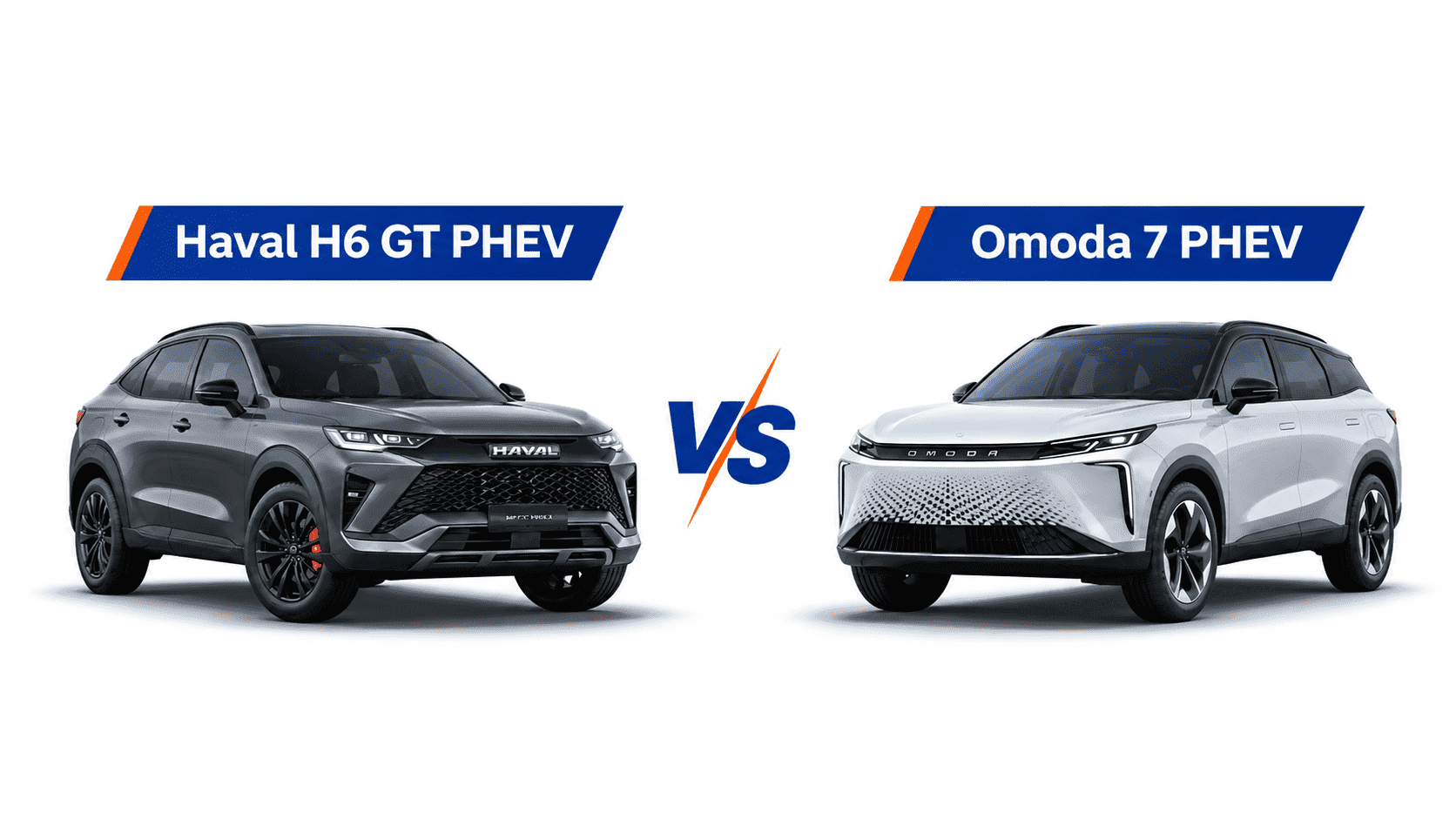
Haval H6 GT PHEV vs Omoda 7 PHEV – Battle of the Luxury Chinese EV SUVs
The Pakistani car market is changing rapidly. This is the kind of a sentence that you have been hearing since automotive blogs have been in existence in Pakistan. You read any 10-year-old blog on any website and you will read something like this. How is the industry changing? How the new cars are coming but the truth is it took a lot of effort and has not always been the case. In reality it has only been for the last 5 or 6 years that the things have started to change.
And I believe it is fair to say that China is leading the charge here with all sorts of cars, manufacturers, models, variants and vehicles. Hence today’s blog.
In this blog, we will be discussing two major and premium hybrid vehicles offered by Chinese automakers, the Haval H6 GT PHEV versus the Omoda 7 SHS-P. Both vehicles are premium mid-size coupe-SUVs and come with advanced plug-in hybrid (PHEV) drivetrain making both of them ideal contenders for this comparison.
Before we start, let’s make it clear that the SHS-P is Omoda’s branding name for the plugin hybrid technology with some minor tweaks.
We all know the fuel prices in Pakistan change daily and are highly unpredictable. And on top of that, considering the load of traffic on our inadequate infrastructure, it has become kind of a habit for daily commuters to wait for hours stuck in traffic just to reach their destination. In conditions like these, the electric vehicles make more sense than the petrol vehicles. But it is also the reality that the battery powered vehicles are still in the early stage of development at this time at least. And it is going to take at least a few more decades for them to compete with something as reliable as an internal combustion engine.
So, considering that it is quite obvious and sensible to go for a vehicle that not only offers the reliability of an internal combustion engine that runs on fossil fuel and combines that reliability with battery power to reduce the day-to-day running cost of the vehicle. But if you think about that a little indepth, you will find that with the type of electric vehicles that are in the market, one can argue that PHEV vehicles are more desirable because of their internal combustion engines and the backup of their long range batteries.
Price
Like always, let’s start with the prices of both vehicles first. Then we will continue with their specs as long as all the bells and whistles that they offer.
| Vehicle Model | Price (PKR) |
| Haval H6 GT PHEV | 12,949,000 (1.3 crore) |
| Omodo 7 SHS-P | 10,649,000 (1 crore 7 lakh) |
As you can see, the Haval is around 23 lac pricier than the Omoda. The Haval is being offered by Sazgar Engineering, whereas the Omoda is sold by Nishat Group.
Both come with the 1.5-liter turbo petrol engine and both have electric motors powered by batteries. Omoda 7 comes with a 6 year or 150,000 km (whichever comes first) vehicle warranty and 8 years or 160,000 km (whichever comes first) battery warranty. Similarly Haval H6 GT comes with a 6 year or 150,000 km (whichever comes first) vehicle warranty and 8 years or 160,000 km (whichever comes first) battery warranty. But it also offers a 10 years or 1,000,000 km (whichever comes first) warranty for its engine which is pretty cool if we are being honest.
Engine and Powertrian:
Let’s get straight to the heart of both vehicles and what powers them. As I have said above both come with a 1.5-litre internal combustion engine that is powered by a turbocharger.
| Engine | Powertrain | Combined Output | 0-100 km/h | EV Range |
| 1.5L Turbo Petrol | Dual-Motor Intelligent AWD (Hi4) | 430 hp / 642 Nm | 4.58 s | 183 km |
| 1.5L Turbo Petrol | Single-Motor FWD (SHS) | 341 hp / 525 Nm | 8.5 s | 90 km |
As for the battery powered motors, the H6 GT PHEV comes with a dual motor intelligent all-wheel drive system which they call Hi4. On the other hand, Omoda 7 comes with a single motor front wheel drive electric motor system. Being an AWD H6 GT can either send all its power to the rear wheels, or just front wheels, or like any other AWD vehicle, it can do a 50:50 power split between the front and the rear wheels. Unlike older mechanical AWD that was available in vehicles like older Kia Sportage and Hyundai Tucson, the H6 GT’s AWD system is completely digital with electric motors intelligently turning on and off the traction between the front and the rear wheels. All of this is done in milliseconds without any noticeable lag.
The combined horsepower of Haval H6 GT is 430 bhp and 642 newton metres of torque. It does 0 to 100 in 4.58 seconds, which is pretty impressive for a vehicle of this size and weight (over 2 tons).
The combined horsepower of Omoda 7 is 341 bhp and makes around 525 N.m of torque. Omoda does 0 to 100 in 8.5 seconds which is almost double the time it takes Haval H6 GT to reach the same speeds.
The H6 GT comes with a 4-Speed Dedicated Hybrid Transmission (DHT) whereas the Omoda 7 has a Single-Speed Continuous Variable DHT (Dedicated Hybrid Transmission). Where Omoda’s seamless single-speed transmission provides smooth acceleration, at lower speeds, the GT’s transmission sends power of the engine directly to the wheels making it an acceleration beast compared to Omoda.
Talking about the EV range of both vehicles. The Omoda does 90+ (WLTP) kilometers in full EV mode whereas the H6 GT does 180+ (NEDC) kilometres in full EV mode. On the other hand, the total range of both Omoda 7 and Haval H6 GT is 1250 (WLTP) kilometers and almost 1200 (NEDC) kilometres respectively.
One thing that you might have noticed is that one vehicle measures its range in WLTP, whereas the other measures in NEDC. WLTP stands for Worldwide Harmonised Light Vehicles Test Procedure whereas NEDC stands for New European Driving Cycle.
Universally WLTP is recognised as a better and more thorough and rigorous testing system compared to the European driving cycle. NEDC is kind of a softer and lenient testing method of electric vehicles and presents an optimistic range of vehicles compared to the Worldwide Harmonised Light Vehicles Test Procedure. So if we want to convert one into the other, there is a conservative conversion factor of 18% that is applied to the original claimed NEDC range. In this case, 183 km multiplied by 0.82 equals to almost 150 km which is the estimated WLTP range of Haval H6 GT.
Since we are talking about the range of the EV mode of both vehicles, let’s discuss the battery capacity as well. H6 GT has a 35.43 kWh Lithium Iron Phosphate (LFP) battery, whereas the Omoda 7 comes with a smaller 18.4 kWh Lithium Iron Phosphate (LFP) battery.
With a 48 KW DC charging system, you can charge your Haval H6 GT PHEV from 30% to 80% within half an hour. And with the 6.6 KW AC charging system you can do 0% to 100% in 6 hours for the H6 GT PHEV. Omoda 7 can do 30% to 80% in roughly 20 minutes. By the way, both vehicles offer Vehicle-to-Load (V2L) which means you can plug your household electrical appliance into the vehicle’s battery system via the car’s charge port. This is a pretty useful feature if you are out and about camping in the wilderness and you need to plug in your hot water, kettle or your blender for your smoothie. Jokes aside, this can be used for running emergency or spot lights, or road assistance equipment like a tire inflator etc. It is basically a giant battery power bank that can run your necessary electrical stuff.
Dimensions
Let’s start with the outlook of both vehicles. It is pretty obvious that Haval H6 GT is sort of based on the regular H6 but with a slanting roof making it sort of a fastback body style vehicle, but on the other hand, the Omoda looks drastically different with its futuristic and almost contemporary design language.
| Component / Metric | Haval H6 GT PHEV | Omodo 7 SHS-P |
| Overall Length | 4,727 mm | 4,660 mm |
| Overall Width | 1,940 mm | 1,875 mm |
| Overall Height | 1,729 mm | 1,670 mm |
| Wheelbase | 2,738 mm | 2,720 mm |
| Ground Clearance | 170 mm | 200 mm |
As you can see, the H6 GT is a little longer at 4,727 mm compared to the Omoda 7’s 4,660 mm. H6 GT is also wider at 1,940 mm compared to the 1,875 mm of Omoda 7. And same is the case with the height of both vehicles. The GT stands a little taller at 1,729 mm compared to Omoda’s 1670 mm. The road clearance of a motor 7 is the only area where it takes the lead over the Haval H6 GT 200mm versus 170 mm.
When we are talking about the wheelbase of both vehicles, we can see that the H6 GT has an 18 mm longer wheelbase than the Omoda. Although 18 mm doesn’t sound very significant but it must be said that even this small amount adds to the overall comfort of the vehicle in terms of how the engineers have developed the geometry of the vehicle which means how it will perform on the road in terms of handling as well as the comfort for the passengers with a larger room in the interior.
Long story short, Haval H6 GT is a larger vehicle than the Omoda 7.
Suspension and Chassis Design
Just because a vehicle is fast that does not mean it is going to perform well in regards to its handling and comfort. This is where the suspension and chassis design of a vehicle comes in.
The H6 GT is built on “LEMON platform” by the Great Wall Motors which they say has high rigidity and utilises over 71% high strength steel that makes the shell frame of the passengers. As I have said above, the GT comes with not only an internal combustion engine but two electric motors and a big battery pack as well. That means this is a hefty car. It weighs over 2 tons and you need a strong chassis and a suspension design to make sure that your vehicle doesn’t body roll into every other corner. For that reason, the H6 GT comes equipped with sporty and firm dampers to make sure the rear wheels are planted on the ground when driving into the corners or going over the humps and bumps.
Like Great Wall’s LEMON platform, Omoda has Chery’s T1X platform which is made specifically for their hybrid vehicles. Meaning it is made to occupy an internal combustion engine plus an electric motor along with the batteries. One thing to be noted here is that Omoda 7 has a lighter chassis than the H6 GT. Having a lighter chassis means it feels nimble during the slow runs or going into the twisties. Overall vehicle ride feels softer and plushier compared to the sportier feel of the Haval H6 GT’s suspension and chassis.
Both vehicles come with the McPherson strut independent suspension in the front and multilink independent suspension in the rear. You get ventilated disks in both the Haval H6 GT and the Omoda 7 helping you stop in time. The H6 GT comes with 19-in alloy wheels, whereas the Omoda comes with 20-in alloys. As I have mentioned earlier, the Omoda is lighter than the H6 GT; in terms of kilograms Omoda 7 weighs at around 1,780 kg compared to H6 GT which stands at 2050 kg.
Interior, Comfort and Safety Features
One thing about the Chinese car manufacturers is that they offer as many features in a car that they can fit in a package. Similar is the case with these two vehicles and considering both are kind of a premium segment vehicles, you can expect their respective manufacturers to have fitted their vehicles with all sorts of luxuries and amenities up to the brim.
Here is a list of all the features that are available in both vehicles:
| Features | Haval H6 GT PHEV | Omodo 7 SHS-P (Premium Trim) |
| Infotainment Display | 14.6-inch Coffee OS Touchscreen | 15.6-inch 2.5K Star-Rail Glide Screen (Sliding display via 4-finger swipe) |
| Processor / Chipset | Standard Infotainment System | Qualcomm Snapdragon 8155 Intelligent Chipset |
| Audio & Speakers | 9 Speakers with 8-Channel Independent Amplifier & Speed Sensitive Volume Control | 12-Speaker SONY Premium Surround Sound System (with headrest speakers) |
| Head-Up Display (HUD) | W-HUD (Windshield Head-Up Display) | Head-Up Display (HUD) Included |
| Driver Seat Adjustment | 8-Way Power Adjustable with Lumbar Support & Welcome/Memory Function | Power Adjustable with Electric Lumbar Support & Memory Function |
| Front Passenger Seat | 4-Way Power Adjustable | Zero-Gravity Seat with Electric Adjustment & Thigh Support |
| Massage Function | Not Available | 8 Therapeutic Massage Points in Front Passenger Zero-Gravity Seat |
| Seat Heating & Ventilation | Front Seats Heated & Ventilated | Front Seats Heated & Ventilated (Cushions & Backrests) |
| Upholstery & Styling | Leatherette (PVC) with GT-Embossed Red Logo & Faux-Suede Accents | Leatherette Gaming-Style Sport Seats with Contrast Stitching |
| Fragrance System | Not Available | Built-in Cabin Triple Fragrance Dispensers (Dark Temptation, Charming Air, Forest Bath) |
| Climate Control & Filtration | Dual-Zone Auto Climate Control with CN95 Filter & Auto Defogger | Dual-Zone Automatic Air Conditioning with N95 Filter & Auto Defogging |
| Panoramic Sunroof | Expansive Panoramic Sunroof | Power-Opening Panoramic Glass Sunroof with Electric Shade |
| Wireless & USB Charging | Wireless Charging Pad + Front Dual USB + Rear Dual USB AC Ports | 50W Wireless Fast Charging + Front/Rear USB & Type-C Fast Charging |
| Connectivity & App Control | GWM App (40+ Vehicle Functions, Scheduled Charging) + Wireless/Wired CarPlay & Android Auto | CarLinko App (T-BOX Remote Control, Remote Engine Start) + Wireless CarPlay & Android Auto |
| Instrument Cluster | 10.25-inch Instrument Cluster (Adjustable Brightness) | LCD Cluster |
| Tailgate & Entry | Inductive Power Tailgate, Keyless Entry & Button Push Start | Electric Tailgate, Keyless Entry & Remote Engine Start via Smart Key |
| Interior Rearview Mirror | Electronic Internal Anti-Glare Rearview Mirror | Automatic Anti-Glare Interior Rearview Mirror |
If you go through the list you will find out. There are a couple of areas where H6 GT takes the lead and then there are some areas where Omoda 7 takes the lead when it comes to providing superior features. And then there are some areas where it’s a tie between the two.
At a glance you will find out that Haval H6 GT provides better connectivity and app control as well as it has a larger 10.25-inch instrument cluster compared to Omoda.
On the other hand, Omoda 7 takes a lead in infotainment display where it has a 15.6-inch 2.5 k infotainment display system. The system is powered by a Qualcomm Snapdragon 8155 chipset. It has a better 12 speaker Sony premium surround sound system compared to the nine speaker sound system available in the Haval.
Omoda has more seat functions and adjustability as well as a massage function as well. In fact, it is an eight therapeutic massage point function in the front passenger seat and they call it a “Zero Gravity” system.
Omoda 7 also has a fragrance system for your cabin. It is a triple fragrance dispenser system. The fragrances are dark temptation, charming air and forest bath.
Omoda also comes with a 50 watt wireless fast charging system in the cabin. It has front and rear USB and type-c fast charging. It’s not like these features are not available in Haval H6 GT but either the number of features are few or maybe not comparable to the competition.
And then there are features that are available in both vehicles in sort of the same way like the heads-up display, driver seat adjustment which are full of features with lumbar support and memory functions. Similarly, same as the case with the Omoda. Then there is seat heating and ventilation. It’s available in both vehicles. Upholstery and styling is also premium in both vehicles. You get fancy upholstery and styling in both vehicles. It’s a matter of personal choice which ones do you prefer.
The climate control is top notch in both vehicles where you get all sorts of adjustment as well as CN95 air filtration in both the H6 GT and the Omoda 7.
Similarly panoramic sunroof is available in both vehicles. As for the entry into the vehicle, you get a power tailgate with keyless entry and a button push start feature in both vehicles. And then there are small features which are similar in both vehicles like the automatic anti-glare rearview mirror.
Needless to say both vehicles offer a whole bunch of luxuries and features.
And same is the case with the safety features and functions. Here is the list of all the features including ADAS available in both of these cars:
| Safety & ADAS Feature | Haval H6 GT PHEV | Omodo 7 SHS-P (Premium Trim) |
| Airbag Count & Coverage | 6 Airbags (Dual Front, Front Side, Side Curtain Airbags) | 8 Airbags (Dual Front, Front Side, Side Curtain, Driver Knee, Front Row Center Airbag) |
| 360 / Parking Camera | 540 Degree View Camera with Clear Chassis View | 540 HD Panoramic Camera System with Dynamic Guides |
| Dash Cam / Event Recorder | Event Data Recorder (EDR) | Dash Camera + Event Data Recorder (EDR) |
| Adaptive Cruise & Highway ADAS | Adaptive Cruise Control (ACC) + Intelligent Cruise Assistance (ICA) + Traffic Jam Assistance (TJA) | Adaptive Cruise Control (ACC) + Integrated Cruise Assist (ICA) + Traffic Congestion Assist (TDA) + Curve Speed Control (CSA) |
| Autonomous Braking & Forward Safety | FCW + AEB (Automatic Emergency Braking for Pedestrians, Bicycles & Intersections) + Low Speed Emergency Braking | FCW (Forward Collision Warning) + AEB (Automatic Emergency Braking) |
| Lane Keeping Assistance | Lane Departure Warning (LDW) + Lane Keep Assist (LKA) + Lane Centre Keep (LCK) + Emergency Lane Keeping (ELK) | Lane Departure Warning (LDW) + Lane Departure Prevention (LDP) + Emergency Lane Keeping (ELK) |
| Blind Spot & Rear Collision Safety | Blind Spot Detection (BSD) + Lane Change Assist (LCA) + Rear Collision Warning (RCW) + Reverse Side Warning & Braking (RCTA/RCTB) | Blind Spot Detection (BSD) + Rear Collision Warning (RCW) + Rear Cross Traffic Alert (RCTA) + Rear Cross Traffic Braking (RCTB) |
| Door Opening Warning (DOW) | Door Open Warning (DOW) | Door Opening Warning (DOW) |
| Autonomous Parking & Remote Control | Full-Auto Parking + Autonomous Reverse | Key-Fob Remote Parking Assist |
| Traffic Sign & Speed Assist | Traffic Sign Recognition (TSR) + JACC Intelligent Speed Limit + Over-speed Warning | Automatic Speed Limiter (ASL) + Speed Limit Reminder |
| Special Avoidance & Steering ADAS | Intelligent Turning + Intelligent Dodge (evades trucks) + Dynamic Steering Torque (DST) | Curve Speed-Control Assist (CSA) |
| Child & Rear Seat Protection | ISOFIX Seat Anchors + Mechanical Child Proof Safety Locks | ISOFIX Interface + Child Safety Lock + Active Child Detection |
| Driver Monitoring System (DMS) | Driver Drowsiness Detection | Driver Monitoring System – DMS (Fatigue Detection) |
| Braking & Chassis Stability | ESC + TCS + SCM (Secondary Collision) + RMI (Roll Over) + IBC + BAS + HDC + HAC + BOS + BTC | ABS + ESP + EBD + BAS + BOS + MCB (Multi-Collision Braking) + HDC + HAC |
| Radar Sensors | Front Radar (Auto Turn-On) & Rear Radar | Front & Rear Radar |
| Headlight Assist & Lighting ADAS | Automatic High Brightness LED Matrix Headlamps + Way-Home Lighting | Adaptive Intelligent High Beam Control (IHC) + Dynamic Flowing Turn Signals + Music Rhythm Lighting |
Like above you can see that there are some areas where one vehicle supersedes the other at a glass. You will find out that maybe Haval is taking the lead with all sorts of safety and driver assist features compared to the Omoda.
One of the biggest differences and a major upgrade is that the H6 GT comes with a fully autonomous reverse which can reverse the car up to 50 meters out of tight alleyways and an auto parking system which is not available in Omoda. The H6 GT also comes with traffic sign recognition system and intelligence speed limit as well as overspeed warning system. Compared to that, Omoda has automatic speed limiter with speed limit reminder.
The Omoda 7 comes with 8 airbags, one for the driver knee and for the front row centre, but the GT H6 comes with 6 airbags. Omoda also has active child detection.
H6 GT also has intelligent turning as well as “Intelligent Dodge” which is basically warning and automatic assistance for avoiding heavy traffic in case of an imminent collision along with the dynamic steering torque (DST). If you are wondering, DST is basically a feature where the vehicle kind of helps the driver in case there is a loss of traction at low speeds as well as countering side roll in case of heavy crosswinds as well as skidding. On the other hand, Omoda comes with curve speed control assist which in simple terms is a feature where the vehicle slows down in case the entry speed of the vehicle is higher for the type of road curve ahead.
Although both vehicles have all sorts of breaking and chassis stability options, for example:
- ABS – Anti-lock Braking System
- BAS – Brake Assist System
- BOS – Brake Override System
- EBD – Electronic Brakeforce Distribution
- ESC – Electronic Stability Control
- ESP – Electronic Stability Program
- HAC – Hill-start Assist Control
- HDC – Hill Descent Control
- IBC – Integrated Brake Control (manufacturer-dependent)
- MCB – Multi-Collision Braking
- RMI – Roll Movement Intervention (Roll-over Mitigation)
- SCM – Secondary Collision Mitigation
- TCS – Traction Control System
But there are a couple which are only available in Haval and not Omoda like the Roll Movement Intervention and Brake Torque Control which is also known as brake traction control.
Then there are features which are available in both vehicles like the door opening warning, Blind Spot & Rear Collision Safety, radar sensors, Driver Monitoring System (DMS), and Lane Keeping Assistance (LKA), to name a few.
Needless to say, you are safe and comfortable in both vehicles.
Verdict
Well, if you have successfully reached the end of this blog, I would personally like to congratulate you. Secondly, I will keep it simple and just say this; if you want performance and maximum safety for you and your passengers, but you are willing to pay an extra amount of around 2.3 million then Haval H6 GT is the one to go for.
But if you prefer futuristic styling and a vehicle that offers maximum passenger comfort and is hellbent to make sure that you have the most comfortable and luxurious ride of your life, then the Omoda 7 is the one to go for.
Rest it is also a fact that a personal choice plays an important role when it comes to buying a vehicle. Some features are important to some people which may not be the case for a lot of other people. Going through the blog and reading all the specs and the features you might have already come to a conclusion by yourself about both vehicles. You might have already realised that Haval H6 GT is sort of a performance oriented vehicle. I mean it is even in the name. The GT stands for “grand tourer”. That whole vehicle is designed to be a luxurious sporty SUV that is focused to provide you great driving pleasure.
On the other hand, the Omoda is designed to give you a comfortable relaxing ride to take you from point a to point b where you do not have to worry about what is going on outside of your vehicle. You just sit back and relax and enjoy a comfortable “zero gravity” ride.
I hope you guys have learnt something new in this blog. And hopefully it will help to make an educated decision for your next vehicle. Until next time, stay tuned to carmandi.pk social media channels for all the latest news.
And if you are looking for a used car in the market, go check out carmandi.pk for all the pre-inspected vehicles and bid to win your next dream car.